
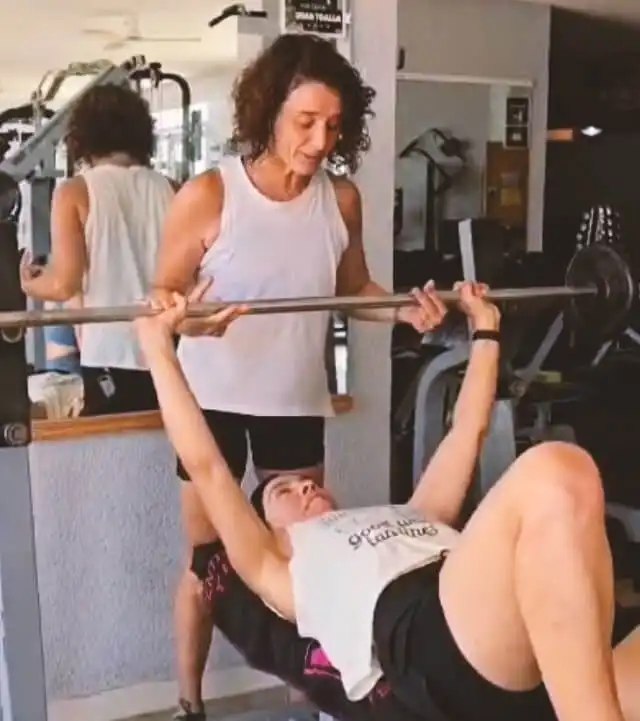
Bench press
The bench press is a free weight exercise that primarily targets the chest muscles, especially the pectoralis major. Additionally, this exercise activates several muscles simultaneously, including the anterior deltoids and triceps. By working with free weights, it also strengthens the stabilizing muscles of the shoulder girdle (upper back). It’s a great way to start training the upper body 💪.
Benefits of the bench press
The bench press is an excellent way to develop strength and endurance in the chest muscles. Besides focusing on the pectoralis major, this exercise also enhances upper body stability by involving multiple muscle groups simultaneously. It’s ideal for increasing muscle mass, improving posture, and strengthening the core.
Suggested routine
For beginners:
- Sets: 3
- Repetitions: 8-10
- Weight: Use a weight that allows you to complete the reps with good form, typically between 10-20 kg.
For advanced level:
- Sets: 4
- Repetitions: 6-8
- Weight: Use a higher weight that challenges you to complete the reps, typically between 30-40 kg.
Proper technique for the bench press
1. Starting position:
- Lie flat on a bench with your feet firmly planted on the floor.
- Grip the bar with your hands slightly wider than shoulder-width apart.
2. Execution:
- Lower the bar slowly until it lightly touches your chest, keeping your elbows at a 45-degree angle.
- Push the bar upwards, extending your arms but not locking your elbows.
- Control the movement at all times to avoid injury.
3. Repetitions:
- Perform 8 to 12 repetitions per set, adjusting the weight according to your strength level and goals.
Variations of the bench press
To maximize the benefits of this exercise, you can try different variations:
1. Incline bench press:
- Perform the exercise on an incline bench to target the upper part of the pectorals.
2. Decline bench press:
- Use a decline bench to focus on the lower part of the pectorals.
3. Dumbbell bench press:
- Switch to dumbbells to increase the range of motion and work the stabilizing muscles.
Additional tips
- Maintain good posture: Ensure your lower back is in contact with the bench and your feet are firmly planted on the floor.
- Control the movement: Avoid jerky movements and make sure each repetition is smooth and controlled.
- Breathe correctly: Inhale as you lower the bar and exhale as you push it up.
- Vary your routine: Change the weight and variations of the exercise to avoid plateaus and keep progressing.
Incorporate this exercise into your training routine and enjoy the incredible benefits for your chest and upper body. Don’t forget to follow me for more fitness and wellness tips!
Category: Chest exercises
Leave a Reply